
Why Purpose-Driven Businesses Don't Need a Funnel: They Need a Loop

By Jen McFarland
Founder,
WomenConquerBusiness.com
Pick one, they said
Most purpose-driven business owners feel the pull. You've probably felt it too. One marketer tells you content is everything. Blog, post, publish, show up on every platform, and eventually the right people find you. Another marketer waves that off. Marketing is relationships, they say. Coffee chats, referrals, real conversations. ... everything else is noise.
So you pick a lane. And then feel vaguely guilty about it either way.
If you went all-in on content, you may have noticed that content gets you found, but attention doesn't always equate to customers on its own. People read the post, nod along, and never reach out. The visibility is real...the conversion? Not so much.
If you leaned entirely on relationships and referrals, you know the other problem. It works beautifully until it doesn't. You can't turn referrals up like a dial when you need more work. Your reach stops at the edge of the people you already know. Good months and lean months arrive without warning, and you can't forecast either one.
Both camps are half right. Content without trust doesn't convert. Relationships without reach limit growth.
The answer then isn't content or relationships. It's balancing content and relationships.
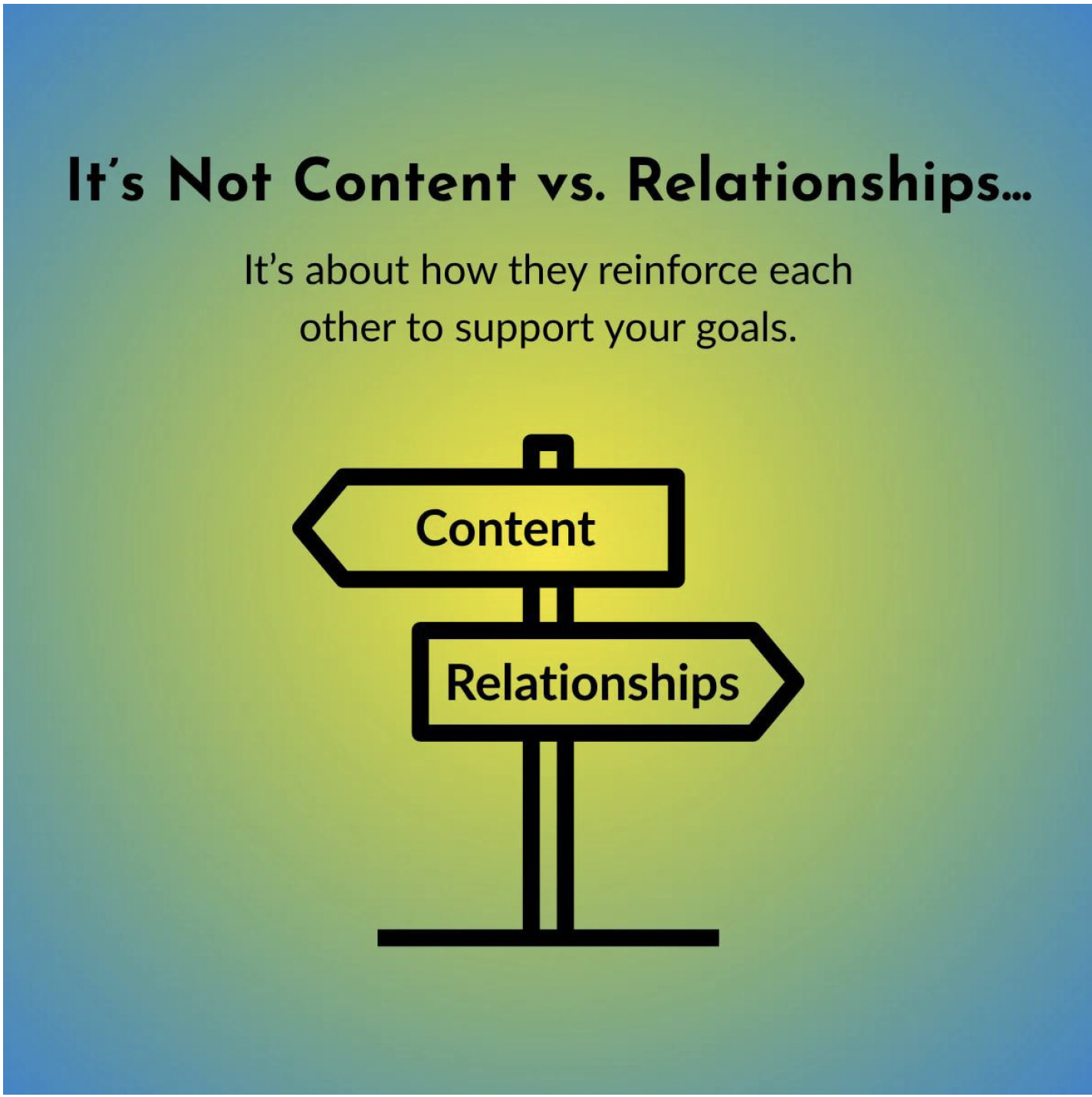
Effective marketing means content and relationships reinforce each other to support your goals.
Stop thinking about the funnel
Fast marketing (aimed at buy now, high-pressure sales) is disconnected from how buyers make decisions. They imagine marketing as a funnel, a one-way slide from stranger to sale, and then they argue about which fuel to pour in the top.
Content or conversations. Pick your input.
But the values-based businesses you admire don't run on a funnel. They run on a loop.
Here's how the loop works:
Your content makes you findable, so the right person discovers you
A good experience with you earns their trust, and trust turns into the thing money can't buy: a review, a referral, someone mentioning your name in a room you're not in
That word of mouth feeds right back into visibility, and new people find you
Then it starts again.
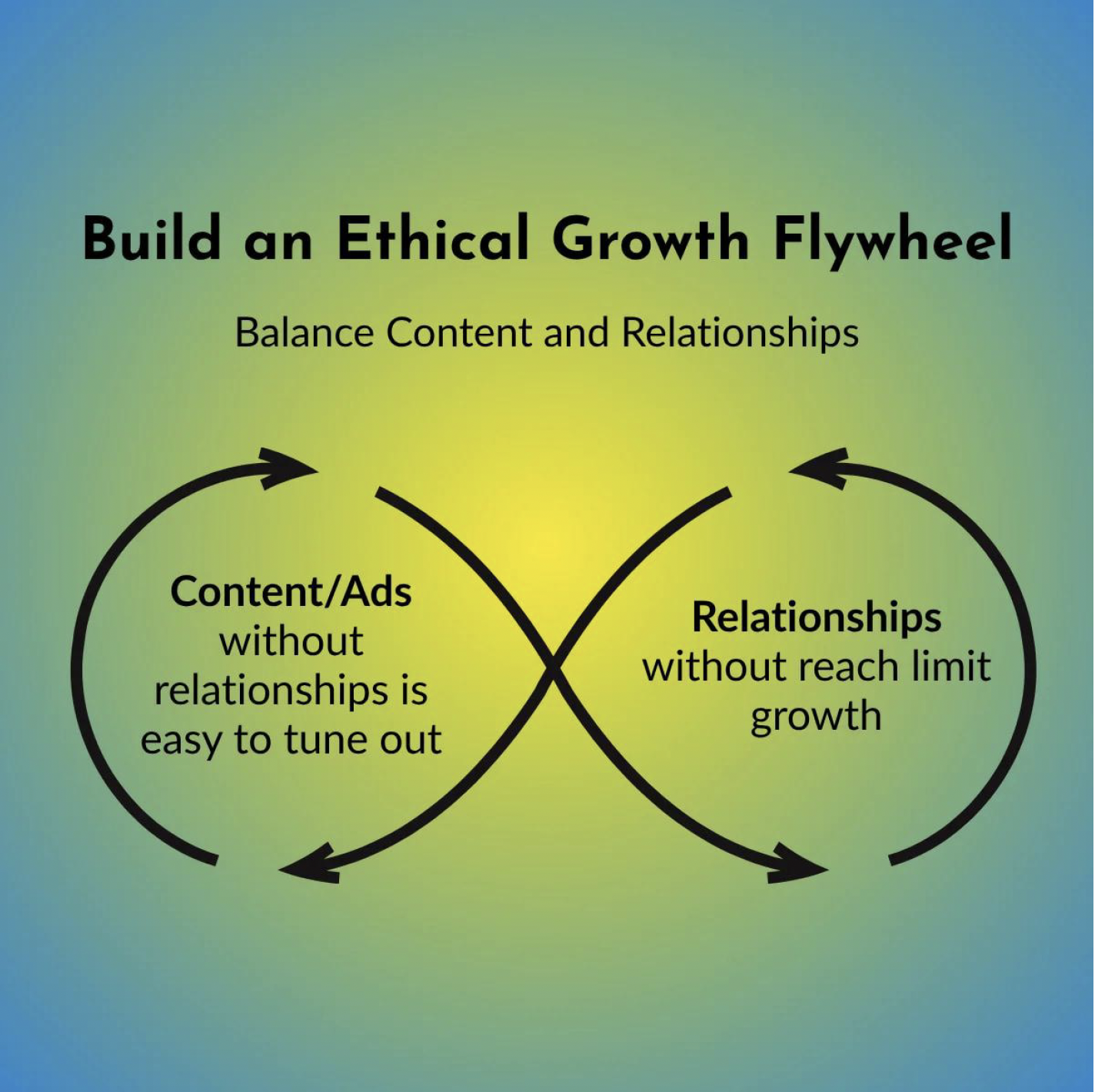
Balance content and relationships to create an ethical growth flywheel.
Content builds visibility. Relationships build trust. And each one keeps supporting the other, which is why you're never choosing between them.
The relief in this: you don't have to be excellent at both. You need a little of each, pointed at the same, right people, so the loop can turn. One of our nonprofit fundraising firm clients has 12 blog posts that position them well and get updated a few times a year resulting in a steady stream of leads from Google. Why? Because they're active in their community, and when people go "check them out" the website content backs them up.
It's time for content and relationships to stop competing for your energy.
Content's primary job: discoverability
Most of the time, content helps you with discoverability. Yes, we create content to bridge people from awareness to consideration to purchase, but usually people need more than a finely-worded post to engage your services. Typically, hiring happens later, after conversations that build trust.
For years discoverability relied on search engine optimization (SEO) keywords so you could land somewhere in Google's ten blue links. That is changing. AI search treats the web less like a ranking list and more like a research corpus it pulls answers from. People ask fuller questions and get answers instead of a page of links, so being findable now means answering customer questions and being a trusted source.
This is good news for you: it's an expert's playground. Specific, tightly focused expertise is more likely to get pulled into an AI answer, because these systems favor precise, high-confidence matches. Google's E-E-A-T framework (experience, expertise, authoritativeness, and trustworthiness) rewards credible content, and AI answer engines follow suit.
So create things only you could make (social media, blogs, newsletters, etc.), for the specific person you want to reach, and make your site visibly credible while you do it.
What does this mean? Include your BCFG certification badge on your website, alongside impact pages and transparency reports.
Trust-building requires boundaries
Every business says it cares about quality, values people, and does good work. Those statements are easy to make and impossible to check, so they tend to be ignored by prospects.
The faster path to building trust is telling people what you won't do, and who you're not for. Explicitly stating who you don't serve is a positioning tactic that increases trust with the people you want.
A purpose-driven business might say it plainly: we will not run manufactured-urgency sales, we don't work with brands that greenwash, or this isn't built for companies looking to cut their people costs. Each one tells the right person they're in the right place and tells the wrong one to keep looking, which spares you both a bad fit later.
As a Benefit Corporation for Good, some of this is easy. Your values — the triple bottom-line (people, planet, profit) — are your competitive advantage. Share your values, provide case studies and client stories to prove your claim.
BUT... a boundary only builds trust if you hold it. Exclusion marketing (e.g., who you don't help) doesn't work if it's performative rather than practice. People notice, and the backlash is costly.
Don't collect business cards, build focused relationships instead
Most networking advice tells you to collect more: more contacts, more coffees, more business cards. That's transactional networking. It treats people like a vending machine: you put in a meeting, you expect a referral to drop out. The interactions stay shallow because everyone can feel the ask lurking underneath.
That's not what I witnessed at the Happy Hour for Good event. Everyone was so caring and supportive: nobody there was working the room for referrals, and that absence of an ask is exactly why the referrals happen.
To balance your time and values while avoiding transactional networking, pick 20 people whose work you genuinely respect and whose values line up with yours. That's it. Twenty is small enough to keep real, personalized contact going without it becoming another job.
Then stay in touch on a regular rhythm (no pitch attached). Send the article that made you think of them. Introduce two people who should know each other. Ask about their work. You're giving without keeping score, which is the whole point. Build relationships before chasing business generates long-term success.
Referrals still come from this. They come voluntarily, from people who trust you, instead of from a favor you're owed. That's steadier, and it burns you out far less.

Ask yourself these questions before you say yes.
Three must-ask questions
Once you understand that content and relationships support each other, you need a way to decide where your limited energy goes because not every opportunity deserves a yes. The invitation to guest on a podcast, the newsletter you keep meaning to send, the networking group that meets at 7am. ... doing it all causes burnout.
Before you commit to any marketing activity, ask three questions:
Does this make me more findable to the right person?
Does this build trust with the people already paying attention?
Does this deepen a relationship with someone whose work I respect?
If a task clears at least one of those, keep it. If it clears none, stop doing it, no matter how much you feel you "should." In our client engagements, we encourage folks to drop a tactic the moment it stops mapping to a business goal.
The 3-question filter, when applied regularly, can cut decision fatigue. It also assures you're deciding on purpose instead of saying yes out of guilt, then resenting your calendar.
Stay the course
Content makes you findable. Trust makes the right people stay. Oh, and the 20 people you keep in genuine touch with? They'll send you work you never had to chase. That's a resilient, algorithm-proof marketing plan.
Jen McFarland is the founder of Women Conquer Business, a Portland-based marketing consultancy built on slow marketing: no manufactured urgency, no hustle, no tactics she wouldn't want used on her. Since 2017 she's helped more than 1,500 small business owners market in a way that matches their values. Subscribe to her newsletter, Ethical Growth Bulletin.